Brake pads: inspect them every 20,000 to 30,000 km before worn linings scratch the discs
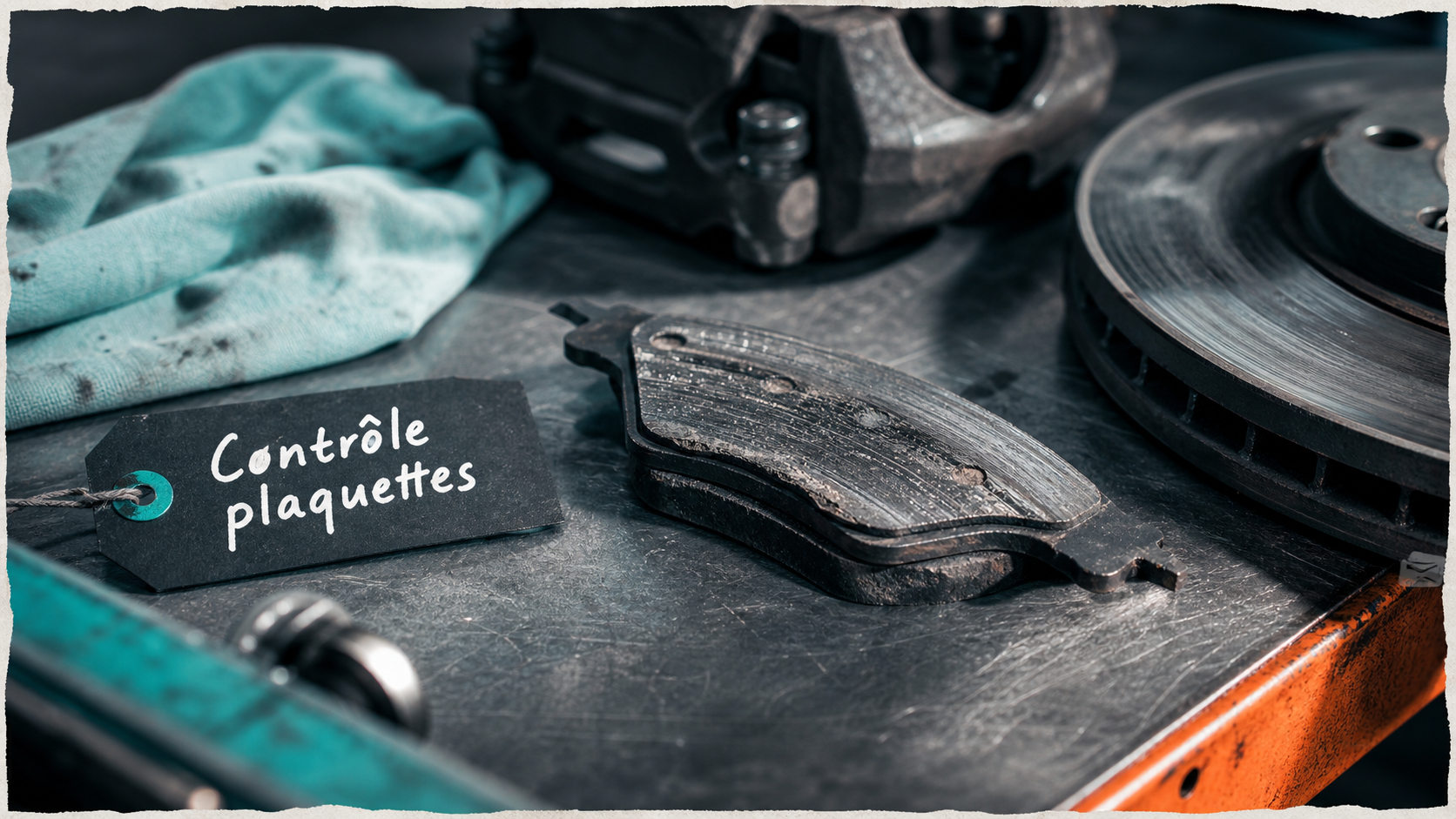
Brake pads are small parts, but they control how confidently a vehicle slows down, stops, and protects its brake discs. If you are checking whether yours need replacing, comparing a set of front brake pads, or trying to understand a warning light, the key is to look at wear before the lining disappears completely.
What brake pads do inside the braking system
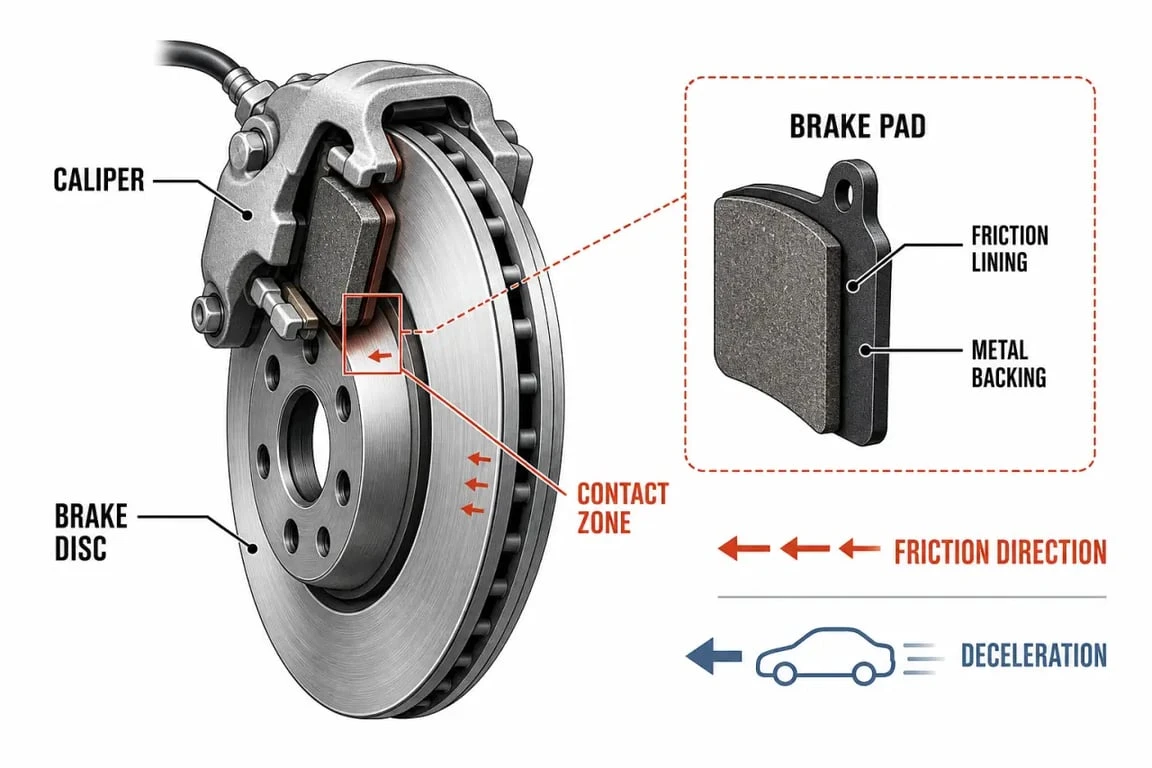
Brake pads are friction components. In a disc brake system, they sit on each side of the brake disc and are pushed by the brake caliper. When you press the brake pedal, the caliper brings the pads into contact with the rotating disc. That contact creates friction, slows the wheel rotation, and helps stop the vehicle.
Comprendre les plaquettes de frein
The principle is simple, but the forces involved are not. Friction transforms kinetic energy into heat, which is why the condition of the pad material matters so much. A pad that is too worn, unsuitable, or badly matched to the vehicle no longer manages that contact as effectively.
Lining and metal support: the two parts that matter
A brake pad is made of a friction lining fixed to a metal support. The lining is the useful wear material. It is designed to press against the disc or drum surface and gradually wear down. The metal support is not meant to brake directly. If the lining disappears, the support can touch the brake disc and scratch it.
This is the wear mistake that often turns a simple pad replacement into a more expensive repair. Replacing worn brake pads on time helps maintain braking quality and can also prevent the need to replace damaged discs.
Disc brakes and drum brakes are not the same layout
Most drivers associate brake pads with disc brakes, where the pads pinch the disc through the caliper. Drum brakes work differently. The friction material presses against the inside of a rotating drum. In both cases, the goal is the same, creating controlled friction against a rotating surface, but the shape, location, and replacement parts differ.
The lining is also softer than steel or cast iron, which helps it wear instead of the drum or disc. That balance is part of the design. It lets the braking system absorb wear where replacement is simpler and cheaper.
When to inspect or replace brake pads
Manufacturers recommend inspecting brake pads every 2 years or between 20,000 km and 30,000 km, depending on the driving environment. This is an inspection interval, not a guarantee that the pads will last exactly that long. Some vehicles and driving habits wear pads faster than others.
A car used mostly in traffic can need attention sooner than a car that covers the same distance on open roads. Mileage helps, but it does not tell the whole story. What matters is how often the brakes are used and how hard they work.
City driving wears pads faster
Urban driving accelerates brake pad wear because it involves repeated starts, stops, traffic lights, roundabouts, and low-speed braking. Even when each stop feels gentle, the constant repetition creates more friction cycles than steady driving on open roads. A city car may therefore need closer attention than a vehicle mostly driven at stable speeds.
Frequent braking also sends heat, pressure, and vibration through the pad, disc, caliper, and fluid circuit. Over time, those small stresses add up. That is why two cars with the same odometer reading can show very different pad thicknesses if one spends its life in dense traffic and the other covers longer, smoother journeys.
Warning lights are late signals, not maintenance plans
A brake pad warning light can indicate significant wear. A brake fluid level warning can also be linked to pad wear, because the braking system compensates as the pads become thinner. These alerts should never be ignored, but it is safer to inspect the pads before relying on dashboard signals alone.
If the pedal feel changes, braking seems less reassuring, or a warning appears, the vehicle should be checked promptly. The goal is not only to restore comfort. It is to preserve braking efficiency and avoid damage to the brake discs.
Front brake pads, rear brake pads, and the number you need
Most cars use 2 brake pads per brake disc. A common full-vehicle setup therefore includes 8 brake pads: 4 front and 4 rear. This is why front brake pads are often sold as a set of 4, covering the two front discs.
That count matters when ordering parts, because buying only by category is not enough. The right set has to match the vehicle and the axle position. A front set and a rear set may look similar, but they are not always interchangeable.
Why front brake pads are often a separate purchase
Front brake pads are a major product category because the front axle does a large share of the braking work on many vehicles. When buying a set, the important question is not just “front or rear?” but whether the shape, dimensions, and technical specification match the vehicle.
Brake pad shape and size vary by brand and model. A visually similar set may not fit the caliper correctly, and compatibility is essential for safe operation. Before buying, check the vehicle make, model, engine, year, and axle position. If a seller provides a fitment checker or vehicle selector, use it carefully rather than choosing by appearance.
Front and rear pads should be checked together
Even if the front pads are the ones being replaced, the rear pads should not be forgotten. Wear can differ between axles, but braking performance depends on the system as a whole. A useful inspection looks at pad thickness, disc condition, warning indicators, and whether the same axle has balanced wear on both sides.
| Item to check | Why it matters |
|---|---|
| Axle position | Front and rear brake pads are not always interchangeable. |
| Number of pads | Most cars use 2 pads per disc, commonly 4 front and 4 rear. |
| Vehicle compatibility | Shape and size vary by brand and model. |
| Disc condition | Scratched discs may reduce braking quality and require replacement. |
Why worn brake pads can damage discs
The most important reason to replace brake pads before maximum wear is disc protection. As the friction lining becomes thinner, the safety margin decreases. Once the lining is gone, the metal support can contact the disc directly. That contact can scratch the disc surface and reduce braking efficiency.
A scratched disc can also make braking less smooth. In practice, a delayed replacement can turn a routine maintenance task into a larger repair, because the disc may also need to be replaced.
The chain reaction of delayed replacement
Delayed replacement creates a simple but costly chain reaction: the lining wears down, the metal support reaches the disc, the disc surface becomes scratched, braking quality drops, and disc replacement may become necessary. Pads are designed to be consumable parts. Discs are more expensive and should not be sacrificed because the pads were left too long.
This is also why a visual inspection is useful. A worn pad may still allow the vehicle to brake, but “it still stops” is not a reliable maintenance standard. Braking must remain stable, predictable, and efficient in normal driving as well as in sudden stops.
Heat management is part of braking performance
Because friction transforms kinetic energy into heat, the braking system must manage temperature. Disc brakes may use grooved or perforated discs to improve ventilation. These designs help heat evacuation, but they do not cancel pad wear. Good ventilation supports performance. It does not replace regular inspection.
The system is built to handle stress, not to ignore it. When heat has somewhere to go, braking stays more consistent. When wear is ignored, the margin for safe use gets smaller.
Materials and use cases: choosing brake pads with the right expectations
Brake pad materials vary according to power needs, durability, aggressiveness, and vehicle use. The right pad is not always the most extreme one. It is the one that suits the vehicle and the driving environment. Compatibility, durability, and vehicle use should guide the choice.
For everyday road vehicles, the priority is consistent braking quality and controlled wear. A pad that is too aggressive for its use may wear discs faster, while a pad that is not suited to the vehicle may fail to deliver the expected feel and durability.
Daily driving versus high-performance braking
At the other end of the spectrum, ceramic is increasingly used in aircraft, Formula 1, and some high-end sports cars, where braking power and heat resistance are critical. Aircraft brakes may also use alternating fixed and rotating discs, in an arrangement similar to a clutch. These examples show how far braking technology can adapt to speed, weight, and heat, but they do not mean a normal road car needs racing-style parts.
For a commuter vehicle in heavy traffic, the safest choice is a reliable set that tolerates frequent braking. For a vehicle used mainly for longer journeys, wear will develop differently. For a sports car or high-performance application, more specialized materials may be needed, but only if the braking system is designed for them.
A practical buying mindset
When choosing brake pads, start with fitment, then consider use. The safest choice is always a compatible set installed before excessive wear. Whether you are buying front brake pads, rear brake pads, or a full set, the decision should protect three things at once: braking efficiency, disc condition, and the predictable feel of the pedal under real driving conditions.
That approach keeps maintenance simple. Check the pads at the recommended interval, watch for warning lights, and replace them before the lining disappears. That is the most direct way to avoid the wear mistake that scars discs.

Articles qui pourraient vous intéresser :
 Ford everest 2024 france : disponibilité, prix, alternatives et importation
 Leasing voiture hybride : 3 formules et les pièges du kilométrage à surveiller

Stage de conduite préventive : 3 situations d’urgence pour tester vos réflexes
 Kia hybride prix : modèles, écarts de tarifs et financement à comparer